


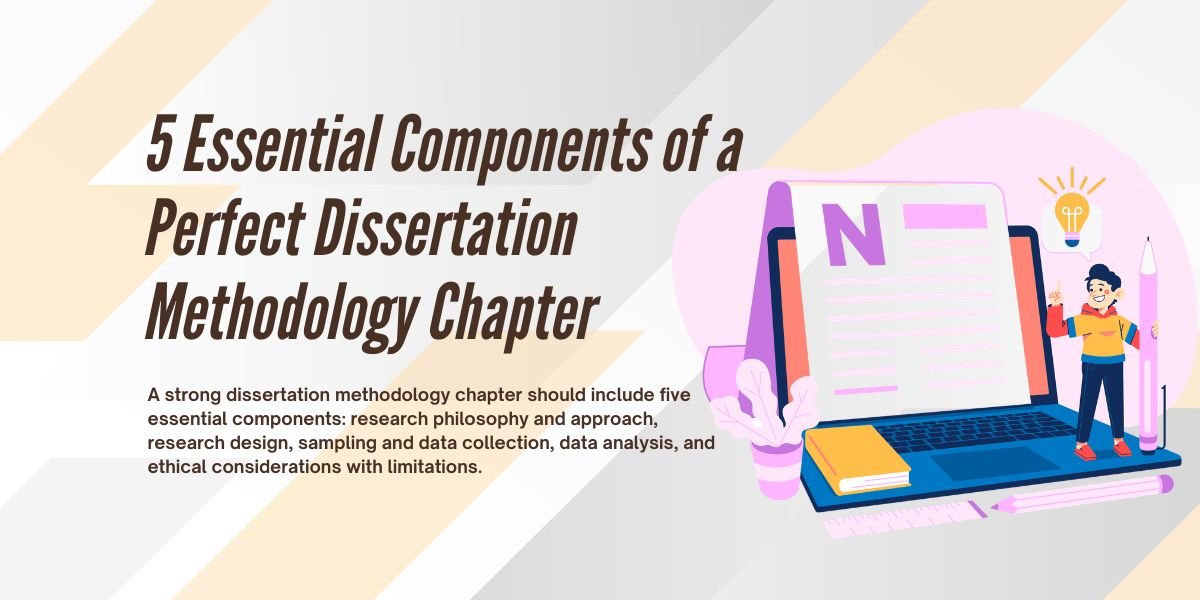
5 Essential Components of a Perfect Dissertation Methodology Chapter
Quick Answer
A strong dissertation methodology chapter should include five essential components: research philosophy and approach, research design, sampling and data collection, data analysis, and ethical considerations with limitations. Each section should explain what you did, why you chose the method, and how it supports your research questions and objectives.
Writing a dissertation methodology chapter is one of the most important stages of academic research. It explains how your research was conducted, why you selected particular research methods, how data was collected and analysed, and how you ensured the quality and credibility of your findings.
A strong dissertation methodology should be clear, logical, well justified, and directly connected to your research questions and objectives. Whether you are writing a master’s dissertation, PhD thesis, doctoral dissertation, or research project, your methodology chapter should demonstrate that your research was conducted systematically and ethically.
What Are the 5 Essential Components of a Dissertation Methodology Chapter?
The five essential components of a dissertation methodology chapter are research philosophy and approach, research design, sampling and data collection, data analysis and research quality, and ethical considerations and methodological limitations. Together, these components explain what research methods were used, why they were selected, how the research was conducted, and how the researcher established the credibility of the study.
| Methodology Component | What It Explains | Main Question It Answers |
|---|
| Research Philosophy and Approach | The theoretical foundation of the research | Why was this research approach selected? |
| Research Design | The overall structure of the study | How was the research designed? |
| Sampling and Data Collection | How participants or data were selected and collected | Where did the data come from? |
| Data Analysis and Research Quality | How data was analysed and evaluated | How were findings produced and validated? |
| Ethics and Limitations | Research responsibility and methodological weaknesses | How were ethical issues and limitations addressed? |
1. What Is Research Philosophy and Research Approach in a Dissertation?
Research philosophy and research approach establish the foundation of your dissertation methodology. They explain how you understand knowledge and how you intend to investigate your research problem.
A research philosophy represents the assumptions that guide your research. Common philosophical positions include positivism, interpretivism, pragmatism, and realism.
Your research approach explains how you move between theory and evidence.
What Are the Main Research Approaches?
There are three commonly discussed research approaches.
Deductive Approach
A deductive approach generally begins with existing theories or concepts. The researcher develops hypotheses or propositions and then collects data to test them.
For example, a researcher studying employee motivation may begin with an established motivation theory and develop hypotheses about the relationship between motivation and employee performance.
Inductive Approach
An inductive approach generally begins with observations or collected data. The researcher identifies patterns and develops concepts or explanations from those findings.
This approach is often suitable for qualitative research where the researcher wants to understand experiences, perceptions, or behaviours.
Abductive Approach
An abductive approach involves moving between existing theory and empirical evidence to develop the most plausible explanation for the research findings.
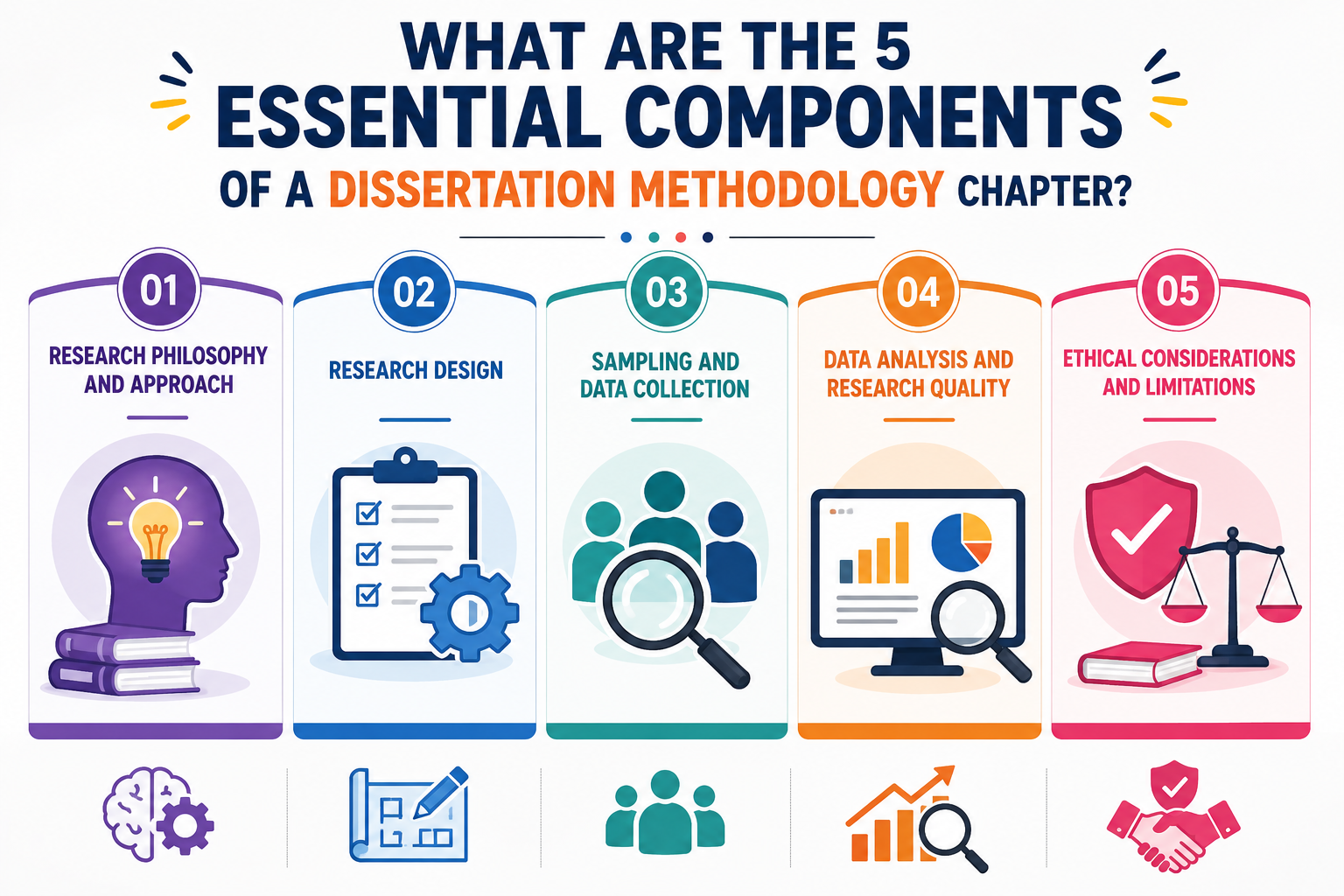
5 Essential Components of a Dissertation Methodology
2. What Is Research Design in a Dissertation Methodology?
Research design is the overall plan that explains how your research will be conducted. It connects your research questions with your methods of collecting and analysing data.
A suitable research design helps ensure that the research process is organised and capable of answering the research questions.
Research designs can include:
- Experimental research
- Descriptive research
- Exploratory research
- Case study research
- Correlational research
- Cross sectional research
- Longitudinal research
- Mixed methods research
The appropriate design depends on your research objectives and the type of evidence required.
What Is the Difference Between Research Design and Research Method?
Research design refers to the overall structure of the study, while research methods refer to the specific techniques used to collect and analyse information.
For example, a researcher may use a cross sectional research design and collect data through an online questionnaire.
The design explains the structure of the study, while the questionnaire is the specific data collection method.
How Do You Choose the Right Research Design?
Start with your research questions.
If your study asks about measurable relationships between variables, a quantitative design may be appropriate.
If your research asks how people experience or understand a particular phenomenon, a qualitative design may be more suitable.
If your research requires both numerical evidence and detailed explanations, a mixed methods design may be appropriate.
The research design should therefore be justified according to what your study needs to discover.
3. How Should Sampling and Data Collection Be Explained?
Sampling and data collection explain who or what was studied and how the research information was obtained.
This is a crucial part of the dissertation methodology because readers need to know where your evidence came from and whether the selected participants or data sources were appropriate.
What Is Sampling in Dissertation Research?
Sampling is the process of selecting a group of participants, cases, organisations, documents, or other units from a larger population for research.
Sampling methods are generally divided into probability and non probability sampling.
How Do You Justify Your Sample Size?
Sample size should not be selected simply because it is convenient.
For quantitative research, sample size can depend on factors such as population size, confidence level, margin of error, statistical analysis, and expected effect size.
Example Structure of Research Questions
To understand this better, imagine a dissertation on student performance in online learning.
- The main research question could focus on how online learning impacts academic performance.
- Sub questions may explore factors such as student engagement, teaching methods, technological challenges, and assessment methods.
- This approach allows you to cover different aspects of the topic while staying connected to the central research problem.
Perfect Research Questions vs Weak Research Question
| Criteria | ✅ Strong / Ideal Research Questions | ❌ Weak / Poor Research Questions |
|---|---|---|
|
Number of Questions |
One main + 2 to 5 sub questions |
Too many or too few without balance |
|
Clarity |
Clear, specific, and easy to understand |
Vague, confusing, or too broad |
|
Focus |
Each question covers a unique aspect |
Overlapping or repetitive questions |
|
Relevance |
Aligned with research objectives |
Unrelated to main problem |
|
Feasibility |
Achievable with available data and time |
Difficult or impossible to answer |
|
Depth of Analysis |
Encourages detailed insights |
Leads to shallow analysis |
|
Structure |
Logical and well-organized |
Disorganized or unclear |
4. How Should Data Analysis Be Explained in a Dissertation Methodology?
Data analysis explains how raw research data was transformed into meaningful results.
The analysis technique should be selected according to your research questions, research design, data type, and research objectives.
Simply mentioning software such as SPSS, R, Python, NVivo, or Stata is not enough. You should explain the analytical procedures used and why they were appropriate.
What Methods Are Used for Quantitative Data Analysis?
Quantitative dissertations may use techniques such as:
- Descriptive statistics
- Frequency analysis
- Correlation analysis
- Regression analysis
- T tests
- Analysis of variance
- Factor analysis
- Structural equation modelling
For example, if your research examines whether employee training influences job performance, regression analysis may be appropriate for examining the relationship between the variables.
What Methods Are Used for Qualitative Data Analysis?
Qualitative research may use:
- Thematic analysis
- Content analysis
- Narrative analysis
- Discourse analysis
- Grounded theory analysis
If thematic analysis is used, explain how interview transcripts or other qualitative data were coded and how themes were developed.
5. What Ethical Considerations and Limitations Should a Methodology Chapter Include?
Ethical considerations explain how the rights, privacy, safety, and interests of research participants were protected.
Methodological limitations explain weaknesses or constraints associated with your chosen research design and methods.
Both are important because they demonstrate that you understand the responsibilities and boundaries of your research.
What Is the Ideal Structure of a Dissertation Methodology Chapter?
A typical dissertation methodology chapter may follow this structure:
3.1 Introduction
Introduce the purpose of the methodology chapter and briefly explain what it covers.
3.2 Research Philosophy
Explain the philosophical position guiding the research.
3.3 Research Approach
Explain whether the research uses a deductive, inductive, or abductive approach.
3.4 Research Design
Explain the overall structure and design of the research.
3.5 Research Method
Explain whether the study uses quantitative, qualitative, or mixed methods research.
3.6 Population and Sampling
Describe the target population, sampling strategy, sample size, and participant selection process.
3.7 Data Collection Methods
Explain the research instruments and procedures used to collect data.
3.8 Data Analysis Methods
Explain how quantitative or qualitative data was analysed.
3.9 Reliability, Validity, or Trustworthiness
Explain how the quality and credibility of the research were established.
3.10 Ethical Considerations
Explain how participant rights, confidentiality, consent, and data protection were addressed.
3.11 Methodological Limitations
Discuss important limitations and explain how they were managed.
3.12 Chapter Summary
Summarise the major methodological decisions and prepare the reader for the next chapter.
Common Dissertation Methodology Mistakes to Avoid
Using Methods Without Justification
Do not simply state that you used questionnaires, interviews, or statistical analysis. Explain why the method was appropriate.
Writing Too Much General Theory
The methodology chapter should focus on your research. Avoid turning the chapter into a textbook explanation of research philosophy.
Choosing a Method Because It Is Easy
Convenience alone is not an academic justification. Your method should be appropriate for your research questions and objectives.
Providing Insufficient Sampling Information
Readers should know who participated, how participants were selected, and why the sample was appropriate.
Mentioning Software Without Explaining Analysis
Saying that SPSS or another software package was used does not explain your analytical methodology.
Hiding Research Limitations
Every methodology has limitations. Acknowledging them demonstrates critical awareness rather than weakness.
Ignoring Ethical Considerations
If your research involves participants, explain how consent, confidentiality, privacy, and data protection were addressed.
A perfect dissertation methodology chapter is not simply a description of the methods you used. It is a carefully reasoned explanation of how your research was designed, why particular methods were selected, how the data was collected and analysed, and how the credibility of the research was established.
Frequently Asked Questions About Dissertation Methodology
A dissertation methodology chapter generally includes research philosophy, research approach, research design, research methods, sampling, data collection, data analysis, research quality, ethical considerations, and methodological limitations. The exact structure should follow your university’s dissertation guidelines.
There is no universal word count for a methodology chapter. The required length depends on your university, academic discipline, dissertation type, and overall word count. The chapter should contain enough detail to explain and justify your research methods without unnecessary information.
Research methods are the specific techniques used to collect or analyse data, such as questionnaires, interviews, experiments, statistical analysis, or thematic analysis.
Research methodology is broader. It explains the reasoning and principles behind your methodological choices.
Connect your methodological decisions directly to your research questions and objectives. Explain why your chosen research philosophy, design, sampling strategy, data collection method, and analysis technique are appropriate for answering your research questions.
Yes. This is known as mixed methods research. It can be appropriate when your research requires both numerical evidence and detailed qualitative understanding.
However, you should clearly explain why combining the two approaches is necessary and how the two types of data will complement each other.
Quantitative methodology generally focuses on numerical data, measurable variables, statistical relationships, and hypothesis testing. Qualitative methodology generally focuses on experiences, perceptions, meanings, behaviours, and detailed contextual understanding.
You should not copy another researcher’s methodology. You can study published research and previous dissertations to understand how methodologies are structured, but your methodology should be developed according to your own research questions, objectives, research design, and data requirements.
About The Author

Writing Tree
Specialized in Thesis, Dissertation & Research Writing
Helped scholars achieve plagiarism-free content
Share this:
- Share on Facebook (Opens in new window) Facebook
- Share on X (Opens in new window) X
- Share on Tumblr (Opens in new window) Tumblr
- Share on Reddit (Opens in new window) Reddit
- Share on LinkedIn (Opens in new window) LinkedIn
- Share on WhatsApp (Opens in new window) WhatsApp
- Share on Threads (Opens in new window) Threads
- Share on Pinterest (Opens in new window) Pinterest
- Share on Bluesky (Opens in new window) Bluesky

