


What Are Some Literature Tips When Writing Critical Answers?
Quick Answer
When writing a critical literature answer, focus on analysis rather than plot summary. Understand the question, develop a clear argument, use relevant textual evidence, analyse language and literary techniques, explore themes and character development, consider context and alternative interpretations, and connect every paragraph back to the question.
Writing a critical answer in literature is not simply about explaining what a poem, novel, play, or short story says. A strong critical answer shows that you can understand the text, interpret its deeper meaning, evaluate the writer’s choices, and support your ideas with relevant textual evidence.
Whether you are answering a literature question in school, college, university, or an academic examination, the difference between an average answer and an excellent one often comes down to the quality of analysis. You need to move beyond retelling the story and explain why the writer has presented ideas, characters, language, themes, and events in a particular way.
This guide explains practical literature tips for writing critical answers that are clear, analytical, well supported, and academically effective.
What Is a Critical Answer in Literature?
A critical answer is a response that examines a literary text closely and develops an argument about its meaning, techniques, themes, characters, or ideas.
Instead of simply saying what happens in a novel, for example, a critical answer asks questions such as:
What does this event reveal about the character?
Why has the writer used this particular image or metaphor?
How does the language influence the reader?
What does the text suggest about society, identity, power, love, conflict, or another major theme?
How does the writer develop this idea throughout the text?
Are there alternative ways to interpret the passage?
A critical answer therefore combines understanding, interpretation, evidence, and evaluation.
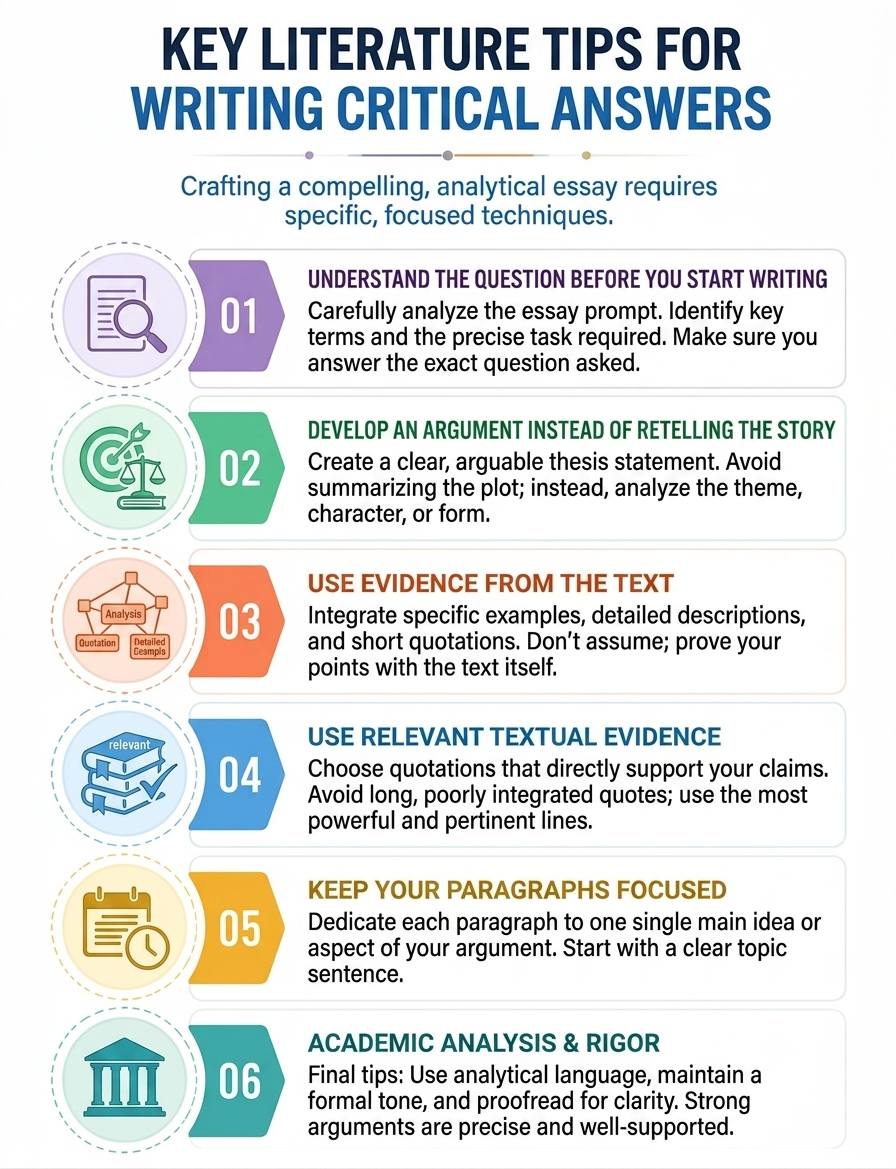
Understand the Question Before You Start Writing
Before writing anything, make sure you understand exactly what the question is asking.
Literature questions often contain important instruction words such as analyse, discuss, explore, examine, evaluate, compare, or assess. Each of these can require a slightly different approach.
Read the question carefully and identify its main focus.
Your answer should remain connected to that focus from the introduction through to the conclusion. Knowing a great deal about a literary text is not enough if the information you include does not help answer the question.
Develop an Argument Instead of Retelling the Story
A critical answer needs a central argument.
Your argument is the main interpretation that you want to develop throughout the response. It gives your answer direction and prevents your discussion from becoming a collection of unrelated observations.
Before you begin writing, think about what you want to say about the text.
Ask yourself what the writer is suggesting about the topic in the question and what position your answer will take.
A clear argument also makes it easier to decide which evidence and ideas are relevant and which can be left out.
What Are Some Literature Tips When Writing Critical Answers?
Use Evidence From the Text
One of the biggest mistakes in literature writing is spending too much time summarising the plot.
Some summary may be necessary to provide context, but it should not dominate the answer.
Critical writing focuses on interpretation.
Instead of concentrating mainly on what happens, think about why an event is important, how the writer presents it, what it reveals about a character or theme, and how it contributes to the wider meaning of the text.
The more you move from description toward interpretation, the more analytical your answer becomes.
Use Relevant Textual Evidence
Critical arguments need support.
Use relevant quotations, references to scenes, descriptions, dialogue, structural details, or other textual evidence to support your interpretation.
The quality of the evidence matters more than the amount.
Choose evidence that directly contributes to your argument and then spend time analysing it. Do not include quotations simply because they sound impressive or because you want to demonstrate that you remember the text.
Every piece of evidence should have a clear purpose.
Keep Your Paragraphs Focused
Each paragraph should have a clear purpose.
Start with a specific analytical point and then develop it using relevant evidence and explanation.
Avoid putting several unrelated ideas into one paragraph.
A well organised answer allows the reader to follow your argument easily and understand how each point contributes to the overall interpretation.
Perfect Research Questions vs Weak Research Question
| ✅ Perfect Literature Review | ❌ Weak Literature Review |
|---|---|
|
Has a clear research focus and purpose |
Lacks a clear focus or research direction |
|
Critically analyses existing studies |
Mainly summarises what other researchers have written |
|
Organises studies around themes, concepts, or arguments |
Lists studies one after another without meaningful connections |
|
Compares and contrasts different studies |
Discusses each study separately |
|
Identifies gaps, limitations, and contradictions in existing research |
Rarely identifies research gaps or limitations |
|
Uses recent, relevant, and credible academic sources |
Relies on outdated, irrelevant, or low quality sources |
|
Connects previous research to the current research problem |
Fails to explain how previous research relates to the current study |
|
Provides a strong foundation for the proposed research |
Provides limited justification for the proposed research |
Make Connections Across the Text
Strong literature answers often make connections between different parts of the text.
Look for recurring themes, images, symbols, relationships, conflicts, and changes in characterisation.
Consider whether something introduced early in the text develops or changes later.
These connections can help demonstrate that you understand the literary work as a complete text rather than focusing on isolated passages.
Write a Focused Introduction
A good introduction should establish your main argument and show how you intend to approach the question.
It does not need to be unnecessarily long.
Avoid beginning with general statements about literature that do not contribute to the answer.
Move quickly towards your interpretation and the main ideas that you will explore.
End With a Strong Conclusion
A conclusion should bring your argument together.
Do not simply repeat every point from the body of your answer.
Instead, explain what your overall analysis reveals about the text.
A strong conclusion can also consider the wider significance of the writer’s ideas and leave the reader with a clear understanding of your interpretation.
What Makes a Literature Answer Critical?
A strong critical literature answer usually includes several important elements:
A clear argument: Your answer has a central interpretation.
Relevant evidence: Your ideas are supported by the text.
Close analysis: You examine language, structure, characterisation, and other relevant elements.
Interpretation: You explain what the evidence suggests.
Context: Relevant contextual knowledge is used where appropriate.
Independent thinking: You develop your own reasoned interpretation.
Critical awareness: You recognise complexity and alternative interpretations when appropriate.
Clear organisation: Your ideas are presented logically.
Focused writing: You stay connected to the question.
Common Mistakes to Avoid
Too Much Plot Summary
Keep the focus on meaning and analysis rather than simply explaining events.
Technique Spotting
Do not list literary techniques without explaining their significance.
Too Many Quotations
Evidence is useful, but detailed analysis is more important than the number of quotations.
Unnecessary Context
Only include contextual information that genuinely helps your interpretation.
Repetition
Avoid making the same point repeatedly. Each paragraph should develop your argument.
Unsupported Interpretation
Your ideas should be connected to evidence and logical reasoning.
Complicated Language
Do not sacrifice clarity in an attempt to sound academic.
Ignoring the Question
Always return to the question and make sure your argument remains relevant.
Final Thoughts
Writing a critical literature answer is ultimately about learning to read beyond the surface.
Do not simply ask what happens in a text. Look at how the writer presents ideas and why particular choices have been made.
Pay attention to language, characters, themes, structure, narrative perspective, setting, context, and reader response. Most importantly, develop your own interpretation and support it with relevant evidence.
You do not need to make your writing unnecessarily complicated. A clear argument, thoughtful analysis, strong textual support, and logical organisation can make a much greater difference.
The best critical answers show that the writer has not only understood the literary text but also taken the time to question it, explore its complexity, and consider the different ways its meaning can be interpreted.
That is what makes literary criticism valuable. It encourages readers to look closely, think independently, and discover meanings that may not be immediately visible on the surface.
Frequently Asked Questions About Critical Literature Answers
The purpose is to analyse and interpret a literary text rather than simply describe its content. A critical answer examines how the writer creates meaning and explores the significance of those choices.
Focus on the questions of how and why. Analyse the writer’s choices, explain their possible meanings, connect evidence to your argument, and consider the wider significance of the ideas presented.
Literary terminology is useful when it helps explain the text. However, identifying techniques should never replace analysis.
No, research questions define what you want to find out, while research objectives explain how you plan to achieve those answers. Both should be closely aligned.
Quotations provide evidence for your interpretation. Select relevant quotations and analyse them carefully rather than using large numbers of quotations without explanation.
Yes, when it is relevant. Context can strengthen an interpretation, but it should be connected directly to the text and the question.
Yes. Literature often allows different interpretations. Recognising ambiguity and considering alternative viewpoints can strengthen a critical response.
Avoid excessive plot summary, technique listing, irrelevant context, repeated ideas, unsupported claims, overly complicated language, and points that do not answer the question.
About The Author

Rachna Yadav
Academic Writing Expert, Active in academic writing
Data Analysis & Interpretation
Helped scholars achieve plagiarism-free content
Share this:
- Share on Facebook (Opens in new window) Facebook
- Share on X (Opens in new window) X
- Share on Tumblr (Opens in new window) Tumblr
- Share on Reddit (Opens in new window) Reddit
- Share on LinkedIn (Opens in new window) LinkedIn
- Share on WhatsApp (Opens in new window) WhatsApp
- Share on Threads (Opens in new window) Threads
- Share on Pinterest (Opens in new window) Pinterest
- Share on Bluesky (Opens in new window) Bluesky

