



How Many Research Questions Should a Dissertation or Thesis Have
Quick Answer
A dissertation or thesis usually has one main research question supported by two to five sub questions. The main question defines the core problem, while the sub questions help explore different aspects in detail. The exact number depends on the complexity of the topic, research level, and methodology, but it is always better to focus on clear and meaningful questions rather than having too many.
Choosing the right number of research questions is one of the most important decisions in any dissertation or thesis. Many students feel confused about whether they should include one strong question or multiple questions. The answer is not fixed, but there are clear academic guidelines that can help you make the right choice.
In this blog, we will explain how many research questions your dissertation should have, what factors influence this number, and how to frame them effectively for better academic results.
Understanding the Role of Research Questions
Research questions act as the foundation of your study. They define the direction, scope, and purpose of your research. Every chapter of your dissertation, including literature review, methodology, analysis, and conclusion, revolves around answering these questions.
A well-defined research question ensures clarity, focus, and logical flow throughout your work. Without clear questions, your research may become scattered and difficult to evaluate.
Ideal Number of Research Questions in a Dissertation
In most academic cases, a dissertation or thesis typically includes one main research question supported by two to five sub questions.
This structure works effectively because the main research question represents the core problem, while the sub questions break it down into smaller, manageable parts. Together, they help you explore the topic in depth without losing focus.
For undergraduate dissertations, students usually work with one main question and two to three sub questions. At the postgraduate or master’s level, it is common to have three to four sub questions. For PhD research, the complexity increases, and students may include four to five sub questions depending on the scope of the study.
However, quality always matters more than quantity. A few well-structured questions are far more effective than many unclear or repetitive ones.
Factors That Influence the Number of Research Questions
The number of research questions in your thesis depends on several important factors.
- The complexity of your topic plays a major role. A simple topic may require fewer questions, while a broad or interdisciplinary topic may need more to cover different dimensions.
- The research methodology also matters. Qualitative studies often explore deeper insights and may require more sub questions. Quantitative studies usually focus on measurable variables and may require fewer, more precise questions.
- The length of your dissertation is another key factor. A longer thesis can accommodate more questions, while a shorter project should stay focused on fewer questions.
- University guidelines should always be considered. Different institutions and supervisors may have specific expectations regarding research structure.
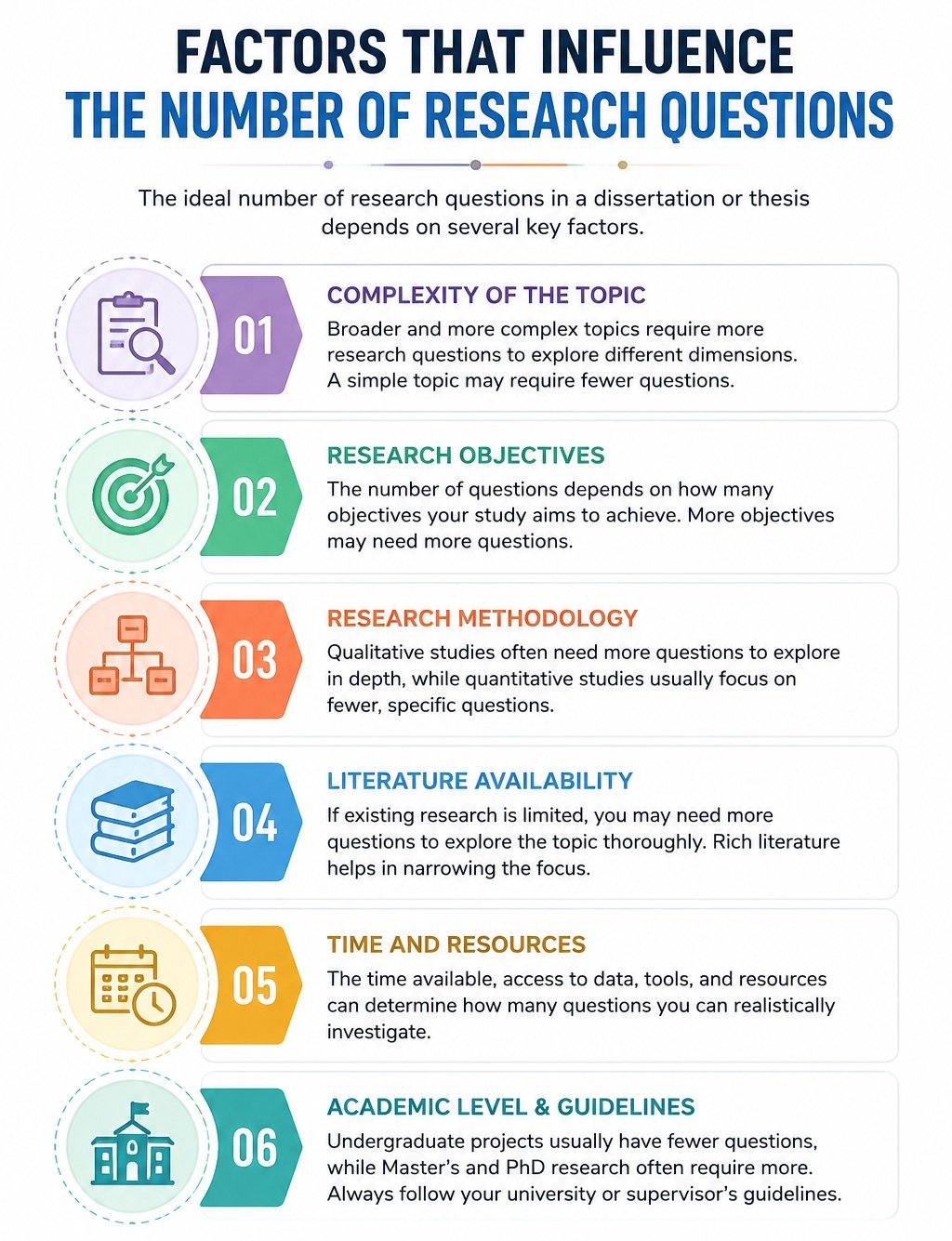
Factors That Influence the Number of Research Questions
How to Frame Effective Research Questions
- Writing good research questions is as important as deciding their number. Strong research questions should be clear, focused, and researchable.
- Research question should avoid being too broad or too vague. Instead of asking a general question, try to narrow it down to a specific issue or relationship.
- Each question should be aligned with your research objectives. There should be a direct connection between what you aim to achieve and what you are asking.
- Your questions should also be feasible. Make sure you have access to the data, tools, and time required to answer them effectively.
Common Mistakes Students Should Avoid
- Many students make the mistake of including too many research questions. This often leads to weak analysis and incomplete answers.
- Another common issue is having questions that overlap or repeat the same idea. Each question should explore a unique aspect of the topic.
- Some students also frame questions that are difficult to measure or answer within the given timeframe. This can create problems during data collection and analysis.
- Keeping your research questions simple, clear, and aligned with your study will help you avoid these issues.
Example Structure of Research Questions
To understand this better, imagine a dissertation on student performance in online learning.
- The main research question could focus on how online learning impacts academic performance.
- Sub questions may explore factors such as student engagement, teaching methods, technological challenges, and assessment methods.
- This approach allows you to cover different aspects of the topic while staying connected to the central research problem.
Perfect Research Questions vs Weak Research Question
| Criteria | ✅ Strong / Ideal Research Questions | ❌ Weak / Poor Research Questions |
|---|---|---|
|
Number of Questions |
One main + 2 to 5 sub questions |
Too many or too few without balance |
|
Clarity |
Clear, specific, and easy to understand |
Vague, confusing, or too broad |
|
Focus |
Each question covers a unique aspect |
Overlapping or repetitive questions |
|
Relevance |
Aligned with research objectives |
Unrelated to main problem |
|
Feasibility |
Achievable with available data and time |
Difficult or impossible to answer |
|
Depth of Analysis |
Encourages detailed insights |
Leads to shallow analysis |
|
Structure |
Logical and well-organized |
Disorganized or unclear |
Why the Right Number of Questions Matters
Having the right number of research questions improves the overall quality of your dissertation. It helps you stay focused, manage your time efficiently, and produce meaningful results.
Too few questions may limit your analysis, while too many can dilute your research. Finding the right balance ensures depth as well as clarity.
There is no fixed rule for how many research questions a dissertation should have, but the ideal approach is to include one main research question supported by two to five well-defined sub questions.
The key is to maintain clarity, relevance, and feasibility. When your research questions are well-structured, your entire dissertation becomes more organized, impactful, and academically strong.
Expert Tips to Make Research Writing Easier
To overcome these challenges, follow these proven strategies:
- Start with a clear research question
- Create an outline before writing
- Use academic databases for credible sources
- Focus on analysis rather than description
- Review and edit your work multiple times
Writing a research paper becomes much easier once you understand where the real difficulty lies.
It is not about formatting or word count, it is about:
- Defining a clear research direction
- Managing information effectively
- Building a strong argument
- Presenting ideas in a structured format
Mastering these elements can significantly improve your academic performance.
A dissertation usually has one main research question supported by two to five sub questions. This helps maintain clarity, focus, and depth in the research.
Yes, a dissertation can have one strong research question, especially for focused studies. However, sub questions are often added to explore different aspects of the topic in detail.
Including too many research questions can make your research unfocused and difficult to manage. It often leads to shallow analysis and weak conclusions.
No, research questions define what you want to find out, while research objectives explain how you plan to achieve those answers. Both should be closely aligned.
Good research questions are clear, specific, researchable, and aligned with your study objectives. They should also be feasible to answer within your time and resource limits.
About The Author

Rachna Yadav
Academic Writing Expert, Active in academic writing
Data Analysis & Interpretation
Helped scholars achieve plagiarism-free content
Share this:
- Share on Facebook (Opens in new window) Facebook
- Share on X (Opens in new window) X
- Share on Tumblr (Opens in new window) Tumblr
- Share on Reddit (Opens in new window) Reddit
- Share on LinkedIn (Opens in new window) LinkedIn
- Share on WhatsApp (Opens in new window) WhatsApp
- Share on Threads (Opens in new window) Threads
- Share on Pinterest (Opens in new window) Pinterest
- Share on Bluesky (Opens in new window) Bluesky

