


What Is the Most Difficult Part of Writing a Research Paper for University? (Complete Guide for Students)
Writing a research paper is one of the important academic tasks for university students in the UK, USA, Canada and other global education systems. People often think that formatting, referencing styles or word count are the parts but that is not true.
The hardest part of writing a research paper is finding a research focus and turning that focus into a strong structured academic argument.
In this guide, from Writing Tree we explain the real problems students deal with and offer useful tips to solve them.
Quick Answer
Q: What is the hardest part of writing a research paper?
The hardest part is choosing a focused research topic, managing large amounts of information, and converting research into a clear, evidence-based argument.
Why Research Paper Writing Feels Difficult
Writing a research paper is not about finding information it is about thinking carefully about what you find and presenting it in a clear way. A lot of students have trouble, with this because they do not know how to use the information they collect to make an argument.
Let us look at the problems people have with this.
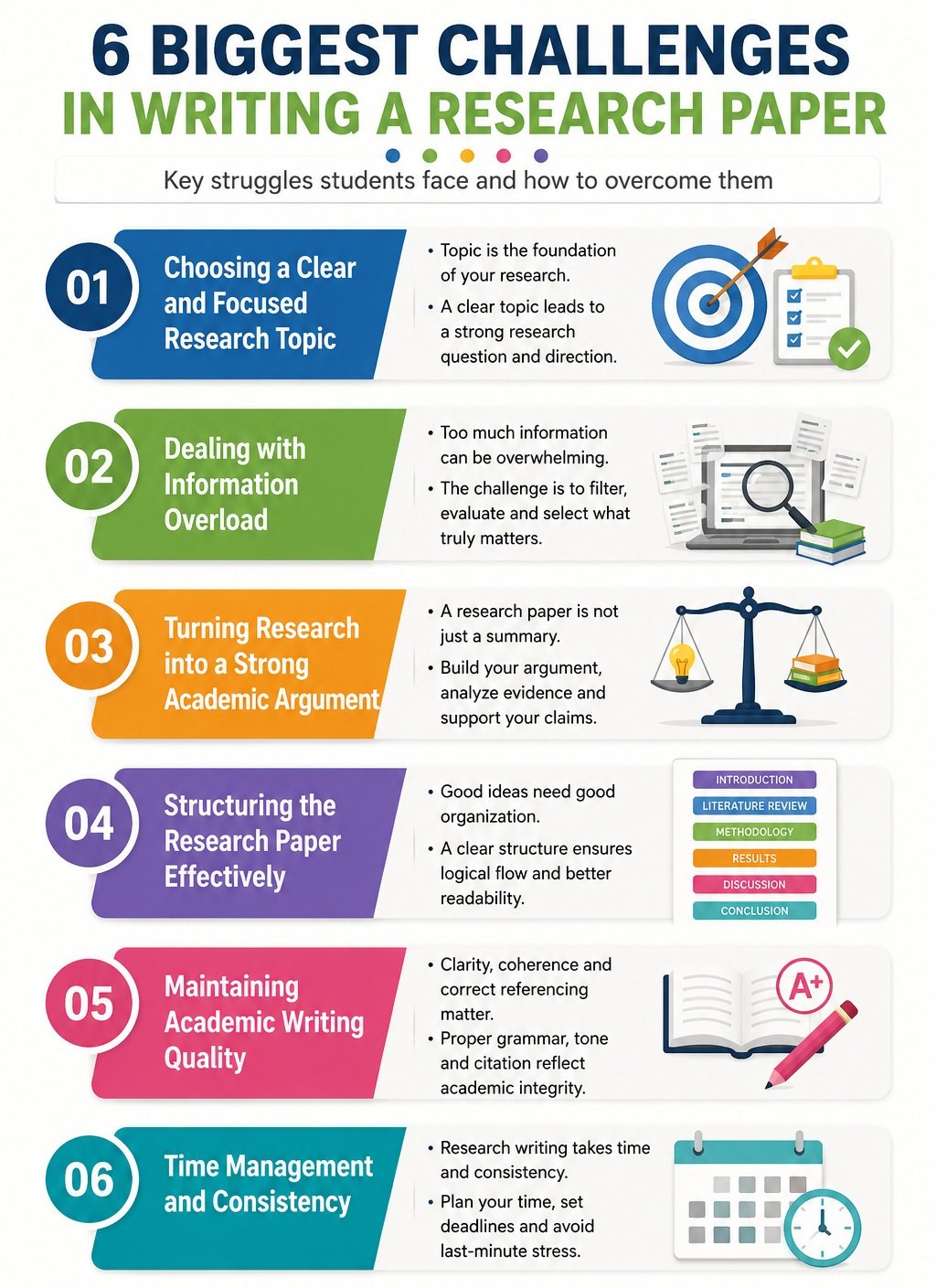
1. Choosing a Clear and Focused Research Topic
One of the big problems people face is finding the right topic for their work.
- The topic is very important.
- Most students begin with ideas that’re not good enough.
- These ideas have some problems.
They are either:
- Too broad, like the impact of technology on our lives
- Too vague, like problems with the education system
- They do not have a direction for research on the education system or technology.
The right topic is important for research, on the topic of technology or the education system.
2. Dealing with Information Overload
Once research begins, students encounter an overwhelming amount of data from:
- Academic journals
- Research papers
- Books and reports
- Online databases like Google Scholar
The Real Problem
The difficulty is not finding information, but filtering and evaluating it.
Students often face:
- Conflicting viewpoints
- Irrelevant data
- Difficulty identifying credible sources
How to Overcome This
- Use peer-reviewed journals
- Focus on recent studies (last 5–10 years)
- Organize sources using themes or categories
This step is crucial for building a strong literature review.
3. Turning Research into a Strong Academic Argument
This is where most research papers fail.
A research paper is not just a summary, it is an analytical document.
Common Mistake
Students:
- Summarize sources
- Repeat information
- Avoid taking a clear position
What You Should Do Instead
- Develop a clear thesis statement
- Support your claims with evidence
- Critically analyze each source
Example:
Instead of writing:
“Many researchers believe social media affects students.”
Write:
“Recent studies indicate that excessive social media usage negatively impacts academic performance by reducing focus and study time.”
This shift from summary to analysis significantly improves the quality of your paper.
4. Structuring the Research Paper Effectively
Even with good research and ideas, poor structure can weaken your paper.
Standard Research Paper Structure
- Introduction
- Literature Review
- Methodology
- Results / Findings
- Discussion
- Conclusion
Common Structural Issues
- Lack of logical flow
- Weak transitions between sections
- Repetition of ideas
5. Maintaining Academic Writing Quality
Many students underestimate the importance of academic tone and clarity.
Challenges Include:
- Poor sentence structure
- Lack of clarity
- Incorrect grammar
- Inconsistent referencing (APA, Harvard, MLA, etc.)
Why This Matters
Even strong research can lose marks if it is poorly presented.
6. Time Management and Consistency
Another hidden challenge is managing time effectively.
Students often:
- Delay topic selection
- Rush research
- Write everything at the last minute
Result:
- Poor-quality work
- Increased stress
- Higher chances of rejection or revision
Solution:
Break your work into stages:
- Topic selection
- Research
- Drafting
- Editing
Why Research Paper Writing Feels Difficult
Expert Tips to Make Research Writing Easier
To overcome these challenges, follow these proven strategies:
- Start with a clear research question
- Create an outline before writing
- Use academic databases for credible sources
- Focus on analysis rather than description
- Review and edit your work multiple times
Writing a research paper becomes much easier once you understand where the real difficulty lies.
It is not about formatting or word count, it is about:
- Defining a clear research direction
- Managing information effectively
- Building a strong argument
- Presenting ideas in a structured format
Mastering these elements can significantly improve your academic performance.
Perfect Research Paper vs Weak Research Paper
| Criteria | ✅ Perfect Research Paper | ❌ Weak / Average Research Paper |
|---|---|---|
|
Research Topic |
Clear, specific, and well-defined |
Too broad, vague, or unclear |
|
Research Question |
Focused and researchable |
Missing or poorly framed |
|
Thesis Statement |
Strong, clear, and arguable |
Weak, generic, or unclear |
|
Literature Review |
Critically analyzed and well-organized |
Mostly descriptive or irrelevant |
|
Use of Sources |
Credible, recent, and properly cited |
Outdated, unreliable, or poorly cited |
|
Argument Development |
Logical, evidence-based, and persuasive |
Lacks depth, mostly summary |
|
Critical Analysis |
Strong interpretation and insights |
Minimal or no analysis |
|
Methodology (if applicable) |
Clearly explained and justified |
Incomplete or unclear |
Choosing a focused topic and developing a clear argument are the most challenging steps.
Because research writing requires critical thinking, analysis, and structured presentation, which many students are not fully trained in.
Practice critical analysis, use credible sources, and follow a clear structure while writing.
Yes, especially due to lack of experience in topic selection, research analysis, and academic writing.
It depends on complexity, but typically ranges from a few days to several weeks.
Yes, professional academic support services like Writing Tree can guide you through each stage of research writing.
About The Author

Rachna Yadav
Academic Writing Expert, Active in academic writing
Data Analysis & Interpretation
Helped scholars achieve plagiarism-free content
Share this:
- Share on Facebook (Opens in new window) Facebook
- Share on X (Opens in new window) X
- Share on Tumblr (Opens in new window) Tumblr
- Share on Reddit (Opens in new window) Reddit
- Share on LinkedIn (Opens in new window) LinkedIn
- Share on WhatsApp (Opens in new window) WhatsApp
- Share on Threads (Opens in new window) Threads
- Share on Pinterest (Opens in new window) Pinterest
- Share on Bluesky (Opens in new window) Bluesky

