


How Can Students Avoid Citation Mistakes When Writing Academic Assignments?
“Learn how to avoid citation mistakes in academic assignments.
When working on academic assignments, many students struggle with citation mistakes, referencing errors, plagiarism issues, academic writing guidelines, and proper citation styles like APA, MLA, and Harvard referencing. These errors not only reduce the quality of your work but can also impact your grades and academic credibility. Understanding how to cite sources correctly is essential for producing high-quality, plagiarism-free assignments.
Why Citation Matters in Academic Writing
Citations play a crucial role in academic writing. They:
- Give credit to original authors
- Strengthen your arguments with credible sources
- Help avoid plagiarism
- Demonstrate research depth and authenticity
Incorrect or missing citations can lead to serious academic consequences, including loss of marks or even rejection of your assignment.
Common Citation Mistakes Students Make
Before learning how to avoid mistakes, it’s important to understand the most common errors:
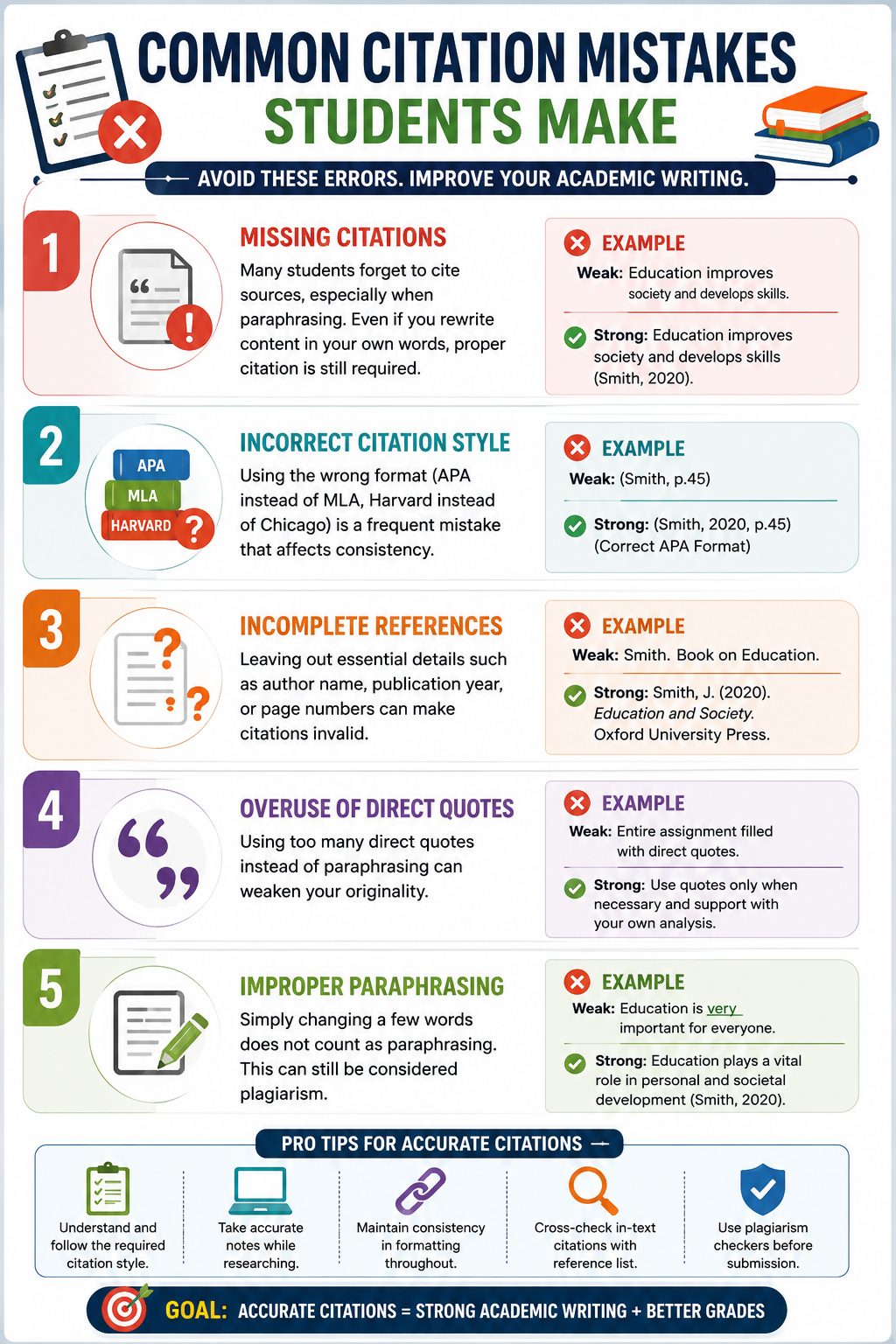
1. Missing Citations
Many students forget to cite sources, especially when paraphrasing. Even if you rewrite content in your own words, proper citation is still required.
2. Incorrect Citation Style
Using the wrong format (APA instead of MLA, Harvard instead of Chicago) is a frequent mistake that affects consistency.
3. Incomplete References
Leaving out essential details such as author name, publication year, or page numbers can make citations invalid.
4. Overuse of Direct Quotes
Using too many direct quotes instead of paraphrasing can weaken your originality.
5. Improper Paraphrasing
Simply changing a few words does not count as paraphrasing. This can still be considered plagiarism.
Common citation mistakes students make
Effective Ways to Avoid Citation Mistakes
1. Understand the Required Citation Style
Always check which citation style your institution requires:
- APA – Common in social sciences
- MLA – Used in humanities
- Harvard – Widely used in universities
Study the format guidelines carefully before starting your assignment.
2. Take Notes While Researching
While collecting information:
- Record full source details (author, title, year, publisher)
- Note page numbers for direct references
- Keep track of URLs for online sources
This prevents last-minute confusion and missing citations.
3. Use Citation Tools (But Carefully)
Tools like citation generators can help, but they are not always 100% accurate. Always review:
- Formatting consistency
- Author names and capitalization
- Punctuation and spacing
4. Learn Proper Paraphrasing Techniques
Good paraphrasing involves:
- Understanding the original content
- Writing it in your own words
- Maintaining the original meaning
- Adding proper citation
5. Maintain Consistency Throughout
Stick to one citation style across your assignment. Avoid mixing formats, as it reflects poor academic practice.
6. Cross-Check Your References
Before submission:
- Match in-text citations with reference list entries
- Ensure no source is missing
- Verify formatting rules
7. Use Plagiarism Checkers
Running your assignment through plagiarism detection tools helps identify:
- Missing citations
- Improper paraphrasing
- Duplicate content
Pro Tips for Accurate Referencing
- Create a reference list as you write, not at the end
- Double-check guidelines provided by your university
- Use official style manuals (APA, MLA guides)
- Avoid copying citations from unreliable sources
Strong vs Weak Citation Style (With Examples)
| Aspects | ✅ Strong Citation (Correct) | ❌ Weak Citation (Incorrect) |
|---|---|---|
|
In-text Citation |
(Smith, 2020) |
(Smith,) |
|
Direct Quote |
“Education improves society” (Smith, 2020, p. 45) |
“Education improves society” (Smith) |
|
Paraphrasing |
Smith (2020) explains that education plays a vital role in societal development. |
Education is important for society. |
|
Reference Entry (APA) |
Smith, J. (2020). Education and Growth. Oxford University Press. |
Smith, Education Book |
|
Reference Entry (Website) |
World Health Organization. (2022). Global Health Report. URL |
Website URL |
|
Consistency in Style |
Entire document follows APA format |
Mix of APA, MLA, and Harvard styles |
|
Author Attribution |
Includes author name, year, and source |
Missing author or incomplete details |
|
Use of Page Numbers |
Includes page number for quotes (p. 45) |
No page number mentioned |
Tip: Strong citations are complete, consistent, and follow a specific referencing style, while weak citations are incomplete, inconsistent, and often lead to plagiarism risks.
Avoiding citation mistakes is not difficult if you follow a systematic approach. Proper referencing enhances the credibility of your academic work and ensures you meet institutional standards. By understanding citation styles, maintaining consistency, and carefully reviewing your work, you can submit assignments that are both professional and plagiarism-free.
If you want to excel in academic writing, mastering citations is not optional—it’s essential.
Citations are important because they give credit to original authors, help avoid plagiarism, and strengthen your arguments with credible sources.
Citation mistakes can lead to loss of marks, reduced credibility, or even plagiarism issues, which may result in serious academic penalties.
The citation style depends on your institution or subject area. Common styles include APA, MLA, Harvard, and Chicago.
No, even when you paraphrase content in your own words, you must still provide proper citation to the original source.
You can review official style guides, use citation tools, and run plagiarism checkers to ensure your citations are accurate and complete.
About The Author

Rachna Yadav
Academic Writing Expert, Active in academic writing
Data Analysis & Interpretation
Helped scholars achieve plagiarism-free content
Share this:
- Share on Facebook (Opens in new window) Facebook
- Share on X (Opens in new window) X
- Share on Tumblr (Opens in new window) Tumblr
- Share on Reddit (Opens in new window) Reddit
- Share on LinkedIn (Opens in new window) LinkedIn
- Share on WhatsApp (Opens in new window) WhatsApp
- Share on Threads (Opens in new window) Threads
- Share on Pinterest (Opens in new window) Pinterest
- Share on Bluesky (Opens in new window) Bluesky

